Predicting the 2026 Western Kenai Salmon Runs
Anglers miss runs by fishing the right river on the wrong week. Twenty-five years of passage data on the Anchor, Crooked Creek, the Kasilof and the Kenai, turned into concrete 2026 timing.
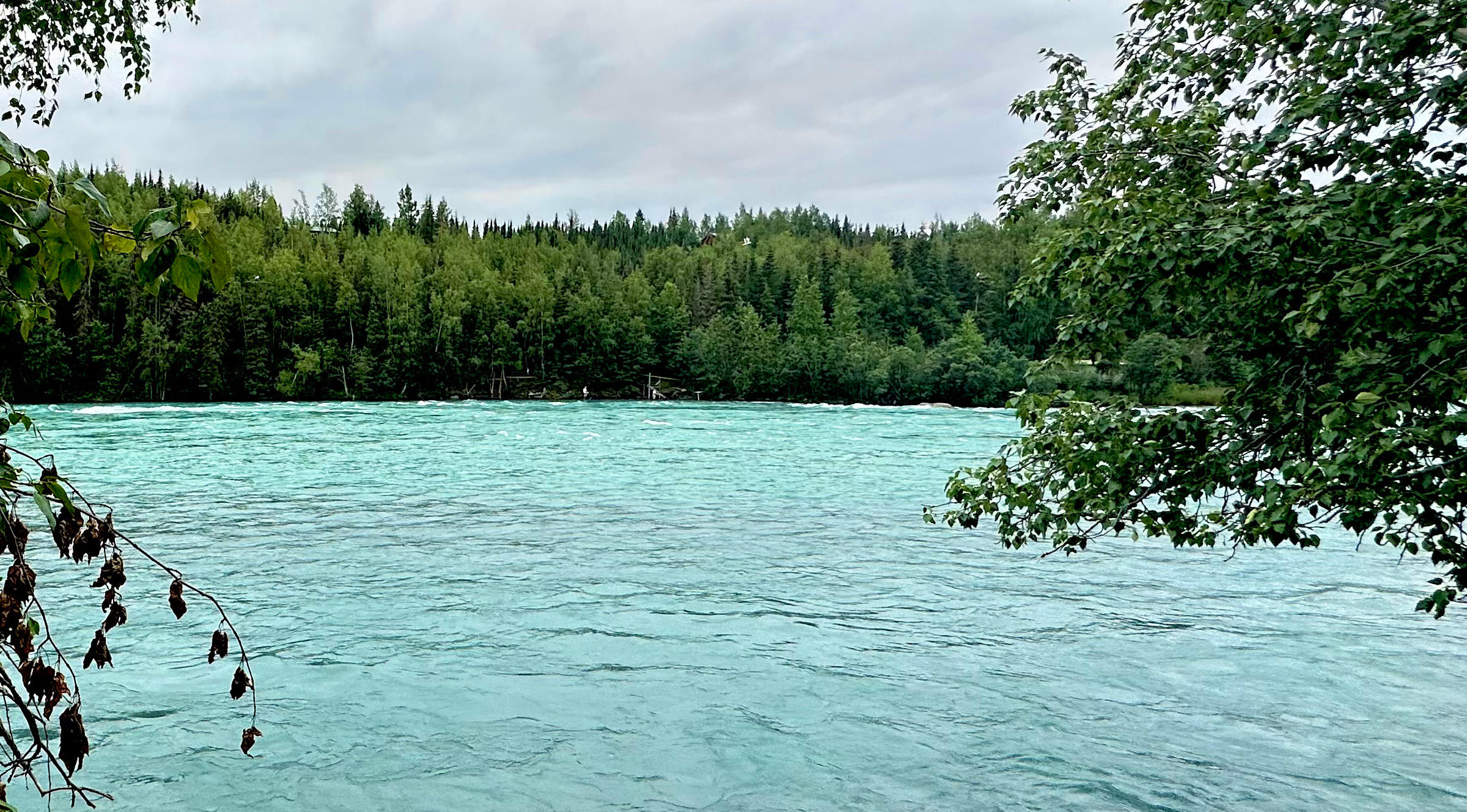
Most anglers don’t miss a salmon run because they fish the wrong river. They miss it because they fish the right river on the wrong week. Run timing on the Western Kenai Peninsula is tighter and more shifty than most planners admit — a peak 10-day window often delivers more fish than the month around it combined. Show up seven days early or seven days late, and you’ve fished a different season.
This post does two things. First, it pulls 25+ years of daily passage data from the Western Kenai’s main counting projects — Anchor River, Crooked Creek, the Kasilof and Kenai sonars, and the Ninilchik weir and Mile-2 sonar — and turns it into concrete 2026 expectations: when the run is likely to start, when it’s likely to peak, and how strong the magnitude looks against historical analogs. Second, it shows where the predictions stop being useful. Run timing wobbles. Single-day counts spike. Recent regimes drift. The honest answer is that history sets your watch, and the live counts tell you when to actually move. That second half is where our app, Salmon Finder ((iOS : Android)), lives.
How We Read the Numbers
The dataset behind this analysis is daily passage counts for each location and species, spanning as far back as 2000 for the Kasilof and Kenai sonars and as recently as a few years at the Ninilchik Mile-2 sonar. Every species/location combination is treated as its own time series, because the runs really are that different.
For each year, we compute four anchors:
- Season start — the day on which 5% of the annual run has passed the counting station. This is the “the bus has left” mark. If you’re not packed by here, you’re chasing.
- Season midpoint — the day on which 50% of the run has passed. This is the calendar pin most anglers should care about most.
- Late-season threshold — the day on which 85% of the run has passed. After this, you’re fishing a tail.
- Peak 10-day window — the consecutive 10-day stretch with the largest total passage of the year. This is the window where being on the water matters most.
We also calculate the share of the annual run that falls inside the peak 10-day window. On most Western Kenai species, that share is between 30% and 55% — a startling concentration that explains why a single missed week can wreck a season.
Salmon don’t return on a calendar — they return on a lifecycle. Chinook and coho cycles tend to run 3–5 years; sockeye are most often 4–5; pinks run on a strict 2-year cycle (which is why even/odd year comparisons matter for them). For each location, we lean on lifecycle analogs — what happened in 2022 (4-year analog), 2021 (5-year analog), and 2020 (6-year analog) — more than we lean on a simple linear trend. A 3-year-old return class doesn’t care that last year was strong; it cares what its parent year looked like.
We also separate timing confidence from magnitude confidence. Timing — when the fish show — is usually fairly stable. Magnitude — how many actually arrive — is much harder, and we are intentionally cautious. A “high timing confidence / medium magnitude confidence” prediction is a prediction we believe in for the calendar but not the size of the pile.
Finally, none of this replaces watching the counts. A 2-day shift in the front edge of a Kasilof sockeye push or a Kenai Chinook pulse changes the whole week. That’s the gap real-time data closes.
Executive Summary: The 2026 Western Kenai Outlook at a Glance
Best overall opportunity: The Kasilof and Kenai sockeye runs. Both are riding a four-year recent regime that has run dramatically higher than the long-term mean, and the lifecycle-analog years (2021 and 2022) were both strong. Magnitude confidence: medium-high. Timing confidence: high.
Strongest expected run: Kasilof sockeye, with the recent regime’s middle 50% of total counts averaging close to one million fish — well over double the 2000–2020 average.
Earliest expected opportunity: Anchor River Chinook front edge, late May. The first 5% threshold across recent years has clustered in the May 28 – June 3 window.
Latest expected opportunity: Anchor River and Lower Cook Inlet stream coho, late August. Anchor’s 5% start has been remarkably stable around August 4–9 across the past two decades.
Most reliable timing predictions: Anchor River coho (midpoint standard deviation: 2.4 days across 14 years), Kenai Chinook (3.6 days across 13 years), and Kasilof sockeye (4.2 days across 26 years). These are the windows you can mark in pen.
Highest-uncertainty predictions: Pink salmon — the dataset doesn’t include a Western Kenai pink series, so we won’t pretend to forecast one. Coho at the Ninilchik weir and Mile-2 sonar — only two years of data each, neither showing meaningful counts. The Ninilchik weir Chinook record stops in 2023, with the Mile-2 sonar now functioning as the active replacement project; treat the weir series as historical only.
Chinook Salmon
Chinook are the trickiest salmon to forecast on the Western Kenai because their runs are smaller, the timing window is wider, and the long-term trend across nearly every site is down. The good news: timing has held remarkably steady even as numbers have softened.
Anchor River. The longest Chinook record on the Western Kenai (23 years from 2003–2025). The long-term mean is about 5,750 fish; the recent 5-year mean is 3,435 fish, roughly 46% below the pre-2021 mean. Timing has drifted later in the recent regime: where the 50% midpoint clustered around day 40–45 from May (early-to-mid June) in the 2000s, it has shifted into late June and early July in 2021–2025. The 4-year analog (2022) returned 3,092 fish; the 5-year analog (2021) returned 4,285. Combined with recent trend, expect another average-by-recent-regime, weak-by-long-history year in 2026. The peak 10-day window has consistently delivered roughly 30–40% of the annual count, so when the front-edge counts climb, the time to fish is now, not next week.
Crooked Creek. Twenty-one years of data (2005–2025). Mean total around 980 fish; recent 5-year mean is 544 fish. The pattern matches Anchor: stable timing (50%-passage standard deviation of just 5 days), declining magnitude. The 50% midpoint sits in early-to-mid July, with the 5% start typically in late June. The 4-year analog (2022) returned 735 fish; the 5-year analog (2021) returned 594. Forecast: average for the recent regime, weak relative to historical baselines.
Kenai (Chinook sonar). Thirteen years (2013–2025). Long-term mean about 17,300; recent 5-year mean 14,580. This is the most predictable Chinook run on the peninsula in terms of timing — the 50% midpoint has stood at days 76–88 (mid-July to late July) every year of the record, with a standard deviation of only 3.6 days. 2024 was a notably weak year (about 8,000 fish); 2025 rebounded to 17,556. The 4- and 5-year analogs (15,476 and 15,963) sit close to the recent average. Forecast: an average Kenai Chinook year with high timing confidence and medium magnitude confidence.
Ninilchik River (weir, 2000–2023). Twenty-four years. Mean about 1,050 fish; the most recent observed 5-year mean (across the years that have data) is 630. The weir series ended in 2023, and the Mile-2 sonar is the active replacement. We won’t forecast the legacy weir for 2026 — it’s no longer the operating project there.
Ninilchik River (Mile-2 sonar). Seven years (2019–2025), so this is a young series. Mean total around 1,000 fish; the seven-year median is essentially unchanged. Timing is earlier than the upriver weir picked up — the 50% midpoint has run mid-to-late June here vs. mid-July at the weir, which is exactly what you’d expect from a downstream sonar catching fish before they reach the weir reach. 4-year analog (2022): 1,011. 5-year analog (2021): 909. Forecast: average with medium timing confidence (only seven years) and medium magnitude confidence.
Practical implication. Western Kenai Chinook are still the headline trophy, but the recent regime has been smaller and slightly later than the historical baseline. Plan around the recent windows, not the 2000s windows. And given how compressed Chinook peak weeks are, this is the species where real-time count alerts pay for themselves the most.
| Species | Location | Expected start (5%) | Expected midpoint (50%) | Expected peak 10-day window | Expected late-season (85%) | Run strength | Confidence (timing / magnitude) | Notes |
|---|---|---|---|---|---|---|---|---|
| Chinook | Anchor River | May 30 – Jun 3 | Jun 29 – Jul 6 | Jun 24 – Jul 8 | Jul 14 – Jul 23 | Average (recent regime), weak vs. long history | High / Medium | Recent regime running ~46% below pre-2021 mean; timing has drifted later. |
| Chinook | Crooked Creek | Jun 27 – Jul 5 | Jul 7 – Jul 14 | Jul 5 – Jul 14 | Jul 17 – Jul 22 | Average (recent regime), weak vs. long history | High / Medium | Stable timing, declining magnitude across the record. |
| Chinook | Kenai (sonar) | Jun 5 – Jun 15 | Jul 21 – Jul 26 | Jul 18 – Jul 28 | Aug 7 – Aug 11 | Average | High / Medium | Most predictable Chinook timing on the peninsula. |
| Chinook | Ninilchik (Mile-2 sonar) | May 28 – Jun 4 | Jun 18 – Jun 30 | Jun 15 – Jun 28 | Jul 15 – Jul 28 | Average | Medium / Medium | Only 7 years of data; downstream of the legacy weir. |
Sockeye Salmon
The story here is unmistakable: the last four to five years on the Western Kenai have been historically large for sockeye, well outside the long-term distribution. Whether 2026 sustains that regime is the only real question.
Kasilof. Twenty-six years (2000–2025). Long-term mean: 477,000. Recent 5-year mean: 940,000. The four most recent years (2022–2025) are all north of 930,000 fish, with 2025 setting a record at nearly 1.2 million. Timing is highly stable: the 50%-passage day has a standard deviation of only 4.2 days, sitting reliably between mid-July and late July. The 4-year analog (2022) was 971,604 fish — the second-largest in the record at the time. The 5-year analog (2021) was 522,000, closer to the long-term mean. Forecast: strong run, possibly very strong, but with medium magnitude confidence because the regime has now run high enough, long enough, that any pullback would still leave a large total. Timing confidence: high.
Kenai (sockeye sonar). Twenty-six years. Long-term mean 1.65 million. Recent 5-year mean 2.5 million. 2025 was a genuine outlier at 4.25 million fish. Timing: 50%-passage standard deviation of 5.3 days, with the midpoint clustering around late July to early August. 4-year analog (2022) was 1.57 million — close to long-term average. 5-year analog (2021) was 2.44 million — close to recent regime. Forecast: strong relative to historical baseline, average-to-strong relative to the recent regime, with the same caveat that the regime has been unusually large. Timing confidence: high. Magnitude confidence: medium.
Practical implication. Sockeye on the Kasilof and Kenai are by far the highest-volume opportunity on the Western Kenai right now. The peak 10-day window historically delivers 30–50% of the entire annual run, and that share has held in the recent regime. The question for an angler isn’t whether the run will arrive — it’s whether you’ll be there during the slug. The runs build in distinct waves, and the front edge can move 3–5 days year to year. Watching daily counts roll in is how you avoid showing up to the back end.
| Species | Location | Expected start (5%) | Expected midpoint (50%) | Expected peak 10-day window | Expected late-season (85%) | Run strength | Confidence (timing / magnitude) | Notes |
|---|---|---|---|---|---|---|---|---|
| Sockeye | Kasilof | Jun 18 – Jun 25 | Jul 15 – Jul 23 | Jul 12 – Jul 25 | Jul 27 – Aug 7 | Strong, possibly very strong | High / Medium | Recent regime nearly 2x the long-term mean. |
| Sockeye | Kenai | Jul 7 – Jul 16 | Jul 21 – Aug 3 | Jul 22 – Aug 4 | Jul 30 – Aug 19 | Strong vs. long history; average–strong vs. recent regime | High / Medium | 2025 was an extreme outlier; 2026 likely below 2025 but well above 2000s baseline. |
Coho Salmon
Coho are the late-season payoff and the species where the dataset is thinnest, especially outside Anchor River. Read this section accordingly.
Anchor River. Fourteen years (2004–2025). Mean total: 3,260 fish; recent 5-year mean 2,131. Long-term decline of about 45%, but timing here is the most predictable on the peninsula — the 50%-passage standard deviation is just 2.4 days. The 5% start has consistently fallen between August 4 and August 11; the 50% midpoint between August 18 and August 24; the 85% threshold between August 24 and August 31. The peak 10-day window often delivers 50%+ of the annual run. The 4-year analog (2022) returned 2,151 fish; the 5-year analog (2021) returned 2,524. Forecast: average in the recent regime with high timing confidence and medium magnitude confidence. This is the kind of run where the calendar prediction is genuinely actionable, and where a real-time count alert would tell you the moment the wave breaks.
Ninilchik River (weir). Two years of usable coho data (2021: 8 fish; 2022: 1 fish). Insufficient. There is no defensible 2026 forecast.
Ninilchik River (Mile-2 sonar). Two years of coho data (2022: 2 fish; 2025: 5 fish). Insufficient. Again, no forecast.
Crooked Creek and Kenai sonars. No coho series in the analyzed dataset for these locations.
Practical implication. For Western Kenai coho, the data points to one workable calendar window — Anchor River, mid-to-late August — and tells you almost nothing about everywhere else. That’s a strong case for treating predictions as a planning anchor and treating real-time counts as the actual decision tool, especially for stream coho where the run can compress into 5–7 days.
| Species | Location | Expected start (5%) | Expected midpoint (50%) | Expected peak 10-day window | Expected late-season (85%) | Run strength | Confidence (timing / magnitude) | Notes |
|---|---|---|---|---|---|---|---|---|
| Coho | Anchor River | Aug 4 – Aug 9 | Aug 18 – Aug 23 | Aug 13 – Aug 23 | Aug 24 – Aug 29 | Average (recent regime) | High / Medium | Most predictable timing in the dataset (std 2.4 days). |
Pink Salmon
The dataset for this region does not include pink salmon counts at any of the analyzed Western Kenai counting stations. There’s no responsible 2026 forecast we can produce from these inputs. Pink salmon return on a strict 2-year lifecycle (even-year and odd-year stocks behave like nearly separate populations), so any forecast would require at least an even-year record stretching back 6–10 years for the relevant streams. That isn’t here.
If you fish pinks on the Western Kenai, the live counts coming through Salmon Finder during the run itself are effectively the only real-time signal available. We’ll revisit pink forecasting when the data supports it.
How the Four Locations Stack Up
If you take the four counting locations as a single comparison set:
Strongest overall: Kasilof and Kenai sonars. Both for raw volume and for the breadth of species/timing they cover. The sockeye opportunity alone makes them the high-density choice.
Most species-specific: Anchor River (Chinook + coho), Crooked Creek (Chinook only in this dataset), Ninilchik (Chinook). These are smaller streams, narrower windows, more sensitive to weekly conditions.
Earlier seasonal value: Ninilchik (Mile-2 sonar) for Chinook in late May / early June, Anchor River Chinook starting late May, Kasilof sockeye front edge in mid-to-late June.
Later seasonal value: Kenai sockeye into early August. Anchor River coho into late August.
Monitor most closely in real time: Anchor River coho (peak window compresses, late-August timing), Kasilof sockeye (large daily counts, fast-moving front edge), Kenai Chinook (small annual totals, very compressed peak window). These three reward live signal more than any others on this list.
Why Predictions Aren’t Enough — and Where Salmon Finder Closes the Gap
Everything above is the playbook. It tells you the seasonal shape, where the windows fall, and what’s reasonable to expect. It is not a substitute for what’s actually happening in the water.
Run timing is variable. The 5%-passage day at Kasilof has shifted as much as 8 days year to year inside the recent regime alone. A 5-day shift on a peak 10-day window is half the window. Daily counts spike without warning — the largest single-day Kenai sockeye count in 2025 was a multiple of the average peak day in 2018. Some rivers and species are more volatile than others; coho compresses faster than sockeye, and small Chinook streams compress fastest of all. Even within a single season, the front edge, the peak, and the tail can each shift independently.
That’s the gap Salmon Finder is built to close. The app pulls the same counts these forecasts are built on — not at the end of the season, but as they’re posted. It plots them on a map of every Western Kenai counting station so you can see the front edge advancing, the peak filling in, or the tail dropping off, on the same screen. Notifications fire when daily counts cross thresholds, when a station registers an unusual spike, or when a run looks like it’s beginning to build.
The pitch is simple: predictions tell you when to get ready. Real-time counts tell you when to go. This blog gives you the seasonal playbook for 2026. The app tells you what’s happening today. Don’t just guess the run — watch it build.
Conclusion
If you fish the Western Kenai in 2026, here is the short version. Mark the predicted windows in this post. Mark the peak 10-day windows in particular — they’re where the lopsided share of the run actually arrives. Then download Salmon Finder, open the map, and turn on notifications for the locations and species you actually fish.
When the predictions and the live counts agree, you’ve got a high-confidence weekend on your hands. When they disagree — when the front edge shows up early, or the peak compresses, or a station spikes out of nowhere — the live counts are what matter, and you’ll be one of the few anglers who knew before the photos hit Facebook.
Read the prediction. Open the app (iOS : Android). Follow the map. Turn on the alerts. Fish the windows.
Counts for every station, on your phone.
Salmon Finder mirrors every daily count ADF&G publishes, with twenty-four seasons behind it. Free, and no account.